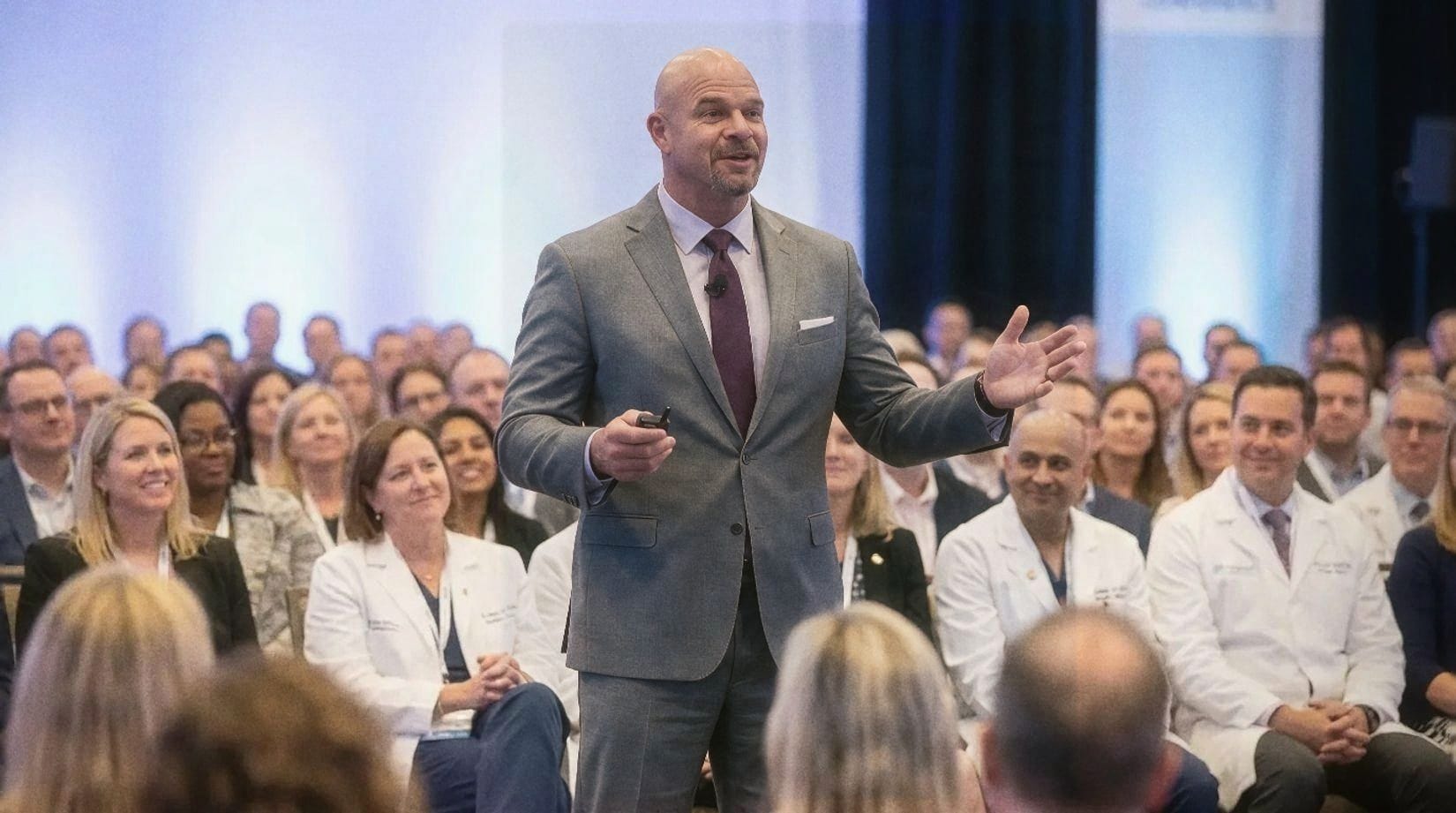
Healthcare Leadership
Your Executives Aren't Out of Time. They're Out of Room.
Most burnout efforts address the workload. Dean addresses what the workload leaves behind — the decisions, the conflicts, and the breaks in trust your executives are still carrying — and the judgment it quietly occupies.
Trusted By Teams At

















For CEOs, CHROs, and the executive teams of health systems.
What your executive team brings into every meeting:
- The physician group that went around them to the board
- The merger that cost them colleagues they trusted, and the org chart they redrew without them
- The engagement survey that named their team, and the meeting where they had to own it
- The predecessor whose decisions they are still answering for
- The expectation that they absorb all of it and look composed doing it
Speaking to the medical staff rather than the executive suite? Physician Leadership →
Why Dean, For This Room
He didn't learn healthcare from the outside. He spent 13 years inside it.
For 13 years, Dean worked inside the healthcare industry as a pharmaceutical representative, in thousands of real conversations with physicians, nurses, physician assistants, and the office managers who hold a practice together. People told him the truth about the exhaustion and the pressure long before either became a headline. He has coached executives one on one since 2013, and today he coaches physicians as well.
He also says plainly what your executives already know and rarely hear acknowledged: the staffing, the margin, and the administrative burden were never their choice. They own constraints they did not create. What he offers is not a substitute for solving any of that. It is what makes the solving possible.
The numbers agree. In a 2022 WittKieffer survey, 74 percent of healthcare executives reported burnout in the prior six months, and 93 percent said it was hurting their organization.
What Dean Addresses in This Room
The Occupied Capacity Beneath the Burnout Numbers
Burnout reads as an empty tank. Dean shows executive teams what is actually occupying their leaders' capacity, and why rest, resilience training, and schedule fixes keep failing to refill it. Writing in Mayo Clinic Proceedings, Arnsten and Shanafelt describe how sustained stress suppresses the prefrontal cortex, the seat of judgment and strategic thinking. The capacity your hardest decisions run on is the first thing the stress response takes offline.
Leaders Can't Create Calm Cultures While Living in Survival Mode
How Emotional Overhead at the executive level spreads through an organization, and what it does to psychological safety, trust, and the people deciding whether to stay.
Releasing the Grievance Without Lowering the Bar
The discipline at the center of Dean's E.D.G.E. Method is forgiveness, practiced as a leadership discipline: private, requiring nothing from anyone else, excusing nothing, and letting no one off the hook. Not reconciliation, and not a softer standard. A leader's decision to stop carrying what the role has handed them, so the judgment the role requires comes back.
Retention Follows the Leader
In BMJ Open, physicians who rate their leader in the top tier are 48 percent less likely to report burnout and 66 percent less likely to intend to leave. Leader capacity is one of the few retention levers an executive team directly controls.
The Keynote for This Room
The Capacity Crisis
Dean's healthcare leadership keynote. Burnout is not an empty tank; it is an occupied one. Grounded in research from Mayo Clinic Proceedings and JAMA Network Open, and built for the clinical and executive leaders holding the system together.
When One Talk Isn’t the Whole Engagement
Workshops
Half-day and full-day sessions where leaders work the E.D.G.E. Method, not just hear it.
Learn more →Executive Coaching
6 or 12 months, one leader at a time.
Learn more →Organizational Partnerships
Annual programs and enterprise-wide capacity building.
Learn more →Designed for C-suites, department chairs, medical directors, and boards. The keynote for a leadership forum or a system summit; the workshop for an executive retreat; coaching for the individual executive; a partnership when the whole enterprise is the room.
Ready to Talk?
Let's Discuss Your Health System
Every engagement starts with a conversation about your organization's goals, audience, and timing.